Tin tức
Tin tức
5-Function Vs 7-Function Electric Hospital Bed: Which Do You Actually Need?
What Does "Function" Mean in Hospital Beds?
In hospital bed specifications, a "function" refers to one independent electric motor-driven adjustment. Each function requires:
One linear actuator (electric motor)
One control input (button, controller position, or lever)
One mechanical linkage to the bed section being adjusted
A 5-function electric bed has 5 independent motors controlling 5 separate bed adjustments. A 7-function electric bed has 7 motors and adds 2 ICU-specific adjustments.
Higher function count = more clinical capability + higher price + more components to maintain.
The 7 Functions Explained
Function 1: Backrest Adjustment (All Electric Beds)
Electric backrest raises the patient's upper body from flat (0°) to upright (60-70°). Used for:
Eating and feeding
Respiratory therapy (head elevation improves oxygenation)
Reading, watching TV, social interaction
Reducing aspiration risk during oral intake
Standard angle range: 0-70°
Function 2: Leg Rest Adjustment (All Electric Beds)
Electric leg rest raises the patient's lower legs from flat (0°) to elevated (30-45°). Used for:
Improving lower limb circulation
Reducing edema (swelling)
Post-operative leg elevation
Patient comfort during long stays
Standard angle range: 0-45°
Function 3: Height Adjustment / Hi-Low (3-Function and Above)
Whole-bed height adjustment moves the entire mattress platform up or down. Typical range: 450mm (low) to 750mm (high). Used for:
Caregiver ergonomic working height
Patient entry/exit (lower for getting in/out)
Procedure height (higher for nursing care)
Fall prevention (lowest position when patient is unattended)
The transition from 2-function to 3-function beds adds height adjustment - this is the critical upgrade that makes electric beds practical for modern nursing.
Function 4: Trendelenburg Position (5-Function and Above)
Trendelenburg tilts the entire bed head-down at 12-30°. Used for:
Shock management (increases venous return to heart)
Central venous catheter insertion
Some abdominal surgical procedures
Lower abdominal access
Standard angle range: 0-30° (head down)
Function 5: Reverse Trendelenburg (5-Function and Above)
Reverse Trendelenburg tilts the entire bed head-up at 12-30°. Used for:
Upper abdominal surgical access
Respiratory therapy (head elevation reduces ventilator-associated pneumonia)
Reducing aspiration risk during feeding
Bariatric patient positioning
Standard angle range: 0-30° (head up)
Function 6: Lateral Turning (7-Function Only)
Lateral turning rotates the patient 15-30° to either side via a dedicated motor. Used for:
Pressure ulcer prevention (every 2-hour turning protocol)
Pulmonary hygiene (lung secretion drainage)
Caregiver injury prevention (no manual lifting)
Skin assessment and wound care
This is the defining 7-function feature. Lateral turning is the single most important addition for ICU patients.
Function 7: CPR Quick-Release (7-Function Only)
CPR quick-release flattens the backrest and Trendelenburg to horizontal in less than 3 seconds via a single lever or button. Used for:
Cardiac arrest response
Emergency resuscitation
Rapid airway management
Code blue situations
Manual flattening of a 5-function bed takes 30-60 seconds - unacceptable delay during cardiac arrest.
5-Function vs 7-Function Comparison
| Specification | 5-Function | 7-Function |
|---|---|---|
| Backrest adjustment | Yes | Yes |
| Leg rest adjustment | Yes | Yes |
| Height adjustment | Yes | Yes |
| Trendelenburg | Yes | Yes |
| Reverse Trendelenburg | Yes | Yes |
| Lateral turning | No | Yes (15-30° each side) |
| CPR quick-release | No | Yes (<3 seconds) |
| Number of motors | 3-4 | 5 |
| Price range (USD) | $1,500 - $2,500 | $3,000 - $5,000 |
| Typical stay duration | Days to weeks | Days to months |
| Best for | General ICU, CCU, post-op, wards | Advanced ICU, long-term critical care |
| Pressure ulcer prevention | Manual turning | Automated lateral turning |
| Resuscitation speed | 30-60 seconds | <3 seconds |
When 5-Function Is Enough
Choose a 5-function electric hospital bed for:
General ICU / CCU
Most ICU patients need Trendelenburg for shock management and reverse Trendelenburg for respiratory therapy - both 5-function features. Lateral turning is helpful but can be performed manually for short stays.
Post-Operative Recovery
Surgical patients benefit from Trendelenburg for drainage and reverse Trendelenburg for respiratory therapy during initial recovery (24-48 hours). Long-term stays are uncommon.
General Medical-Surgical Wards
Ward patients with cardiac, pulmonary, or post-surgical conditions benefit from 5-function positioning for comfort and clinical care.
Long-Term Care Facilities
Nursing homes and rehabilitation centers serve stable patients needing comfort adjustments, not critical care positioning.
Recommended ICARE models: CD-803 (USD 1,500+), CD-804 (USD 1,800+)
When 7-Function Is Necessary
Choose a 7-function electric hospital bed for:
Advanced ICU / Long-Term Critical Care
ICU patients staying 7+ days develop pressure ulcers rapidly without consistent turning. Automated lateral turning prevents complications and reduces nurse workload.
Cardiac Care Units (CCU)
Cardiac patients in CCU have higher cardiac arrest risk. CPR quick-release is essential for rapid resuscitation response.
Stroke Units
Stroke patients are immobile for weeks. Lateral turning is critical for pressure ulcer prevention, and CPR quick-release addresses the elevated cardiac event risk.
Burn Units
Burn patients require frequent position changes for wound care and pressure management. Lateral turning enables this without caregiver injury.
Recommended ICARE model: CD-805 (USD 3,000+)
ICARE 5-Function vs 7-Function Models
| Model | Functions | Load | Lateral Turn | CPR Release | Price (USD) |
|---|---|---|---|---|---|
| CD-803 | 5-function | 250 kg | No | No | $1,500+ |
| CD-804 | 5-function | 250 kg | No | No | $1,800+ |
| CD-805 | 7-function | 300 kg | Yes | Yes | $3,000+ |
CD-803 vs CD-804: Same 5-function specification with different dimensions and accessory packages. CD-804 is slightly larger with extended mattress platform.
CD-805: Flagship ICU bed with 7-function specification, 300 kg load capacity, lateral turning motor, and CPR quick-release. Optional carbon fiber X-ray board for imaging compatibility.
Optimal Deployment Mix
For a typical 200-bed hospital with a 20-bed ICU:
5-function beds: 70-80% of fleet = 140-160 beds (CD-803, CD-804)
7-function beds: 20-30% of fleet = 40-60 beds (CD-805) - concentrated in advanced ICU, CCU, stroke unit
This mix:
Keeps capital cost manageable (70% at lower price points)
Concentrates 7-function capability where it matters most
Provides 5-function flexibility for general ICU and post-op
Frequently Asked Questions
What does "function" mean in a hospital bed?
A function refers to one independent electric motor-driven adjustment. Common functions include backrest, leg rest, height adjustment, Trendelenburg, reverse Trendelenburg, lateral turning, and CPR quick-release.
What is the difference between a 5-function and 7-function hospital bed?
A 5-function bed includes backrest, leg rest, height, Trendelenburg, and reverse Trendelenburg. A 7-function bed adds lateral turning (motorized 15-30° rotation) and CPR quick-release (flattens bed in 3 seconds).
Do I need a 7-function hospital bed?
You need a 7-function bed if you run an advanced ICU, CCU, stroke unit, or burn unit where patients stay 7+ days and require automated pressure ulcer prevention or rapid resuscitation access. For general ICU, post-op, and wards, 5-function beds are sufficient.
How much does a 7-function hospital bed cost?
7-function hospital beds cost USD 3,000-5,000. ICARE CD-805 starts at USD 3,000. The 2x premium over 5-function beds reflects the additional motors and ICU-specific features.
What is lateral turning on a hospital bed?
Lateral turning is a 7-function feature that uses a dedicated motor to rotate the patient 15-30° to either side. It enables pressure ulcer prevention through consistent 2-hour repositioning without manual lifting, reducing pressure ulcer incidence by 23%.
What is CPR quick-release on a hospital bed?
CPR quick-release is a 7-function feature that flattens the backrest and Trendelenburg to horizontal in less than 3 seconds via a single lever. It enables rapid resuscitation response during cardiac arrest, saving 30-60 seconds compared to manual adjustment.
Key Takeaways
"Functions" = independent electric adjustments: Backrest, leg rest, height, Trendelenburg, reverse Trendelenburg, lateral turning, CPR release.
5-function covers 90% of clinical needs: Standard ICU, CCU, post-op, and general wards are well-served by 5-function beds.
7-function is ICU-specific: Lateral turning prevents pressure ulcers; CPR quick-release enables rapid resuscitation response.
Price difference is significant: 5-function beds cost USD 1,500-2,500; 7-function cost USD 3,000-5,000 (2x premium).
Lateral turning reduces pressure ulcers by 23% in ICU patients per Journal of Advanced Nursing research.
CPR quick-release saves 30-60 seconds during cardiac arrest - critical for survival (every minute delay reduces survival 7-10%).
Optimal hospital mix: 70% 5-function (general ICU, post-op, wards) and 30% 7-function (advanced ICU).
Conclusion
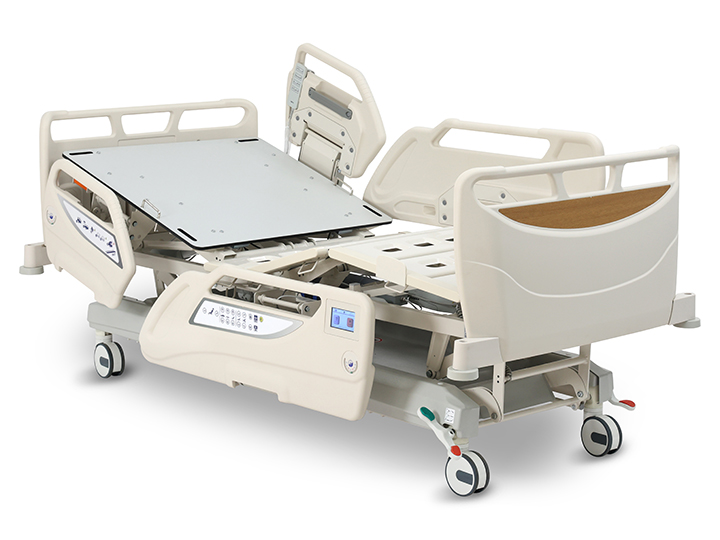
The number of functions on an electric hospital bed directly determines clinical capability and price. 5-function beds (USD 1,500-2,500) cover 90% of clinical scenarios - general ICU, CCU, post-op, and wards. 7-function beds (USD 3,000-5,000) add the two ICU-specific features that matter for critical care: lateral turning for pressure ulcer prevention and CPR quick-release for rapid resuscitation.
For most hospitals, a 70% 5-function / 30% 7-function mix delivers optimal capability and cost. Start by deploying 5-function beds in general ICU and wards, then add 7-function beds in advanced ICU and CCU based on patient acuity.
ICARE manufactures both ranges under ISO 13485: CD-803 and CD-804 for 5-function needs, CD-805 for 7-function ICU requirements. Browse the complete electric hospital bed lineup or compare specifications in detail.
Tin tức được đề xuất
-
Lựa chọn giường nâng bệnh viện và các tình huống sử dụng
-
Phân tích quy trình và kỹ năng thực hành của điều dưỡng phường từ khi nhập viện đến phục hồi chức năng
-
Đặc điểm chức năng và lựa chọn giường khám chẩn đoán và điều trị y tế
-
Giường phục hồi chức năng: chìa khóa nâng cao chất lượng chăm sóc bệnh nhân nằm liệt giường dài ngày
-
Công nghệ chăm sóc người cao tuổi thông minh trao quyền và mở ra kỷ nguyên mới về dịch vụ chăm sóc người cao tuổi
-
Phân tích chức năng và lựa chọn các biện pháp phòng ngừa của giường điện thông minh
-
Hướng dẫn lựa chọn thiết bị phục hồi chức năng và phân tích các loại thông dụng
-
Kỹ năng phân tích và lựa chọn chức năng của giường đồng hành
-
Sự phát triển mới thông minh và dựa vào cộng đồng trong chăm sóc người già tại nhà
◇◇ Nội dung liên quan ◇◇
- Comprehensive Analysis Of Treatment Carts: A Guide To Selecting Key Equipment For Enhancing Medical Efficiency
- The Ultimate Guide To Electric Smart Beds: Feature Analysis And Buying Tips To Enhance Your Sleep Tech Experience
- Complete Guide To Purchasing And Using Manual Hospital Beds: Economical Medical Care Solutions
- Complete Guide To Choosing A Children's Hospital Bed: 7 Key Points To Help You Make An Informed Decision
- Ultimate Guide To Crib Safety: 10 Key Points For Your Baby's Safe Sleep
- What Is An Emergency Bed? Unveiling The Core Functions And Applications Of Key Medical Equipment In ICU, Emergency Departments, And Ambulances
- Transfer Cart: Key Equipment For Enhancing Logistics Efficiency And Selection Guide
- Home Care Beds: The Ideal Choice For Enhancing Quality And Comfort Of In-Home Care
- The Ultimate Guide To Surgical Operating Tables: Core Parameter Analysis And Professional Purchasing Strategy